The Complete Custom Apparel Production Process: A Manufacturer's Guide
Business & Strategy·
Every stage of custom apparel production — sourcing, decoration, software, QC and team kits — in one operator's guide. Get the free handbook.
Every stage of custom apparel production — sourcing, decoration, software, QC and team kits — in one operator's guide. Get the free handbook.
Search "apparel manufacturing process" and you'll find dozens of guides explaining how a t-shirt goes from fabric to finished garment — cutting, sewing, pressing, packing. What almost none of them mention is the step that defines most real custom apparel businesses today: decoration and personalization.
If you run a sportswear brand, a print shop, a uniform supplier, or an eCommerce apparel storefront, your manufacturing process doesn't stop at "sew it and fold it." It includes a customer designing a jersey in 3D, a roster of forty names and numbers that all have to land in the right place, a decision between screen print and DTF, and a software layer that either connects all of that cleanly or turns every order into a manual mess.
This guide covers the full process — from brief to shipped order — including the parts the generic manufacturing guides skip.
The apparel manufacturing process is the sequence of steps that turns a design brief into a delivered, wearable product: sourcing and supplier verification, design and customization, cutting and decoration, sewing and assembly, quality control, and delivery. For custom and decorated apparel specifically, that sequence adds steps a plain-garment definition leaves out entirely — digital design approval, production-file generation, and personalization-data management chief among them.
This is written for sportswear brands, print shops, uniform and team-kit suppliers, and eCommerce apparel sellers — as well as first-time entrepreneurs figuring out whether to build a manufacturing operation or work with an existing one. If you're a clothing manufacturer for startups audience — meaning you're deciding how to produce your first run without overcommitting — the sourcing and software sections below are the ones to read first.
Custom apparel production runs in a repeatable cycle, not a straight line. Every order — whether it's a single custom hoodie or a 500-unit team kit — moves through the same eight gates:
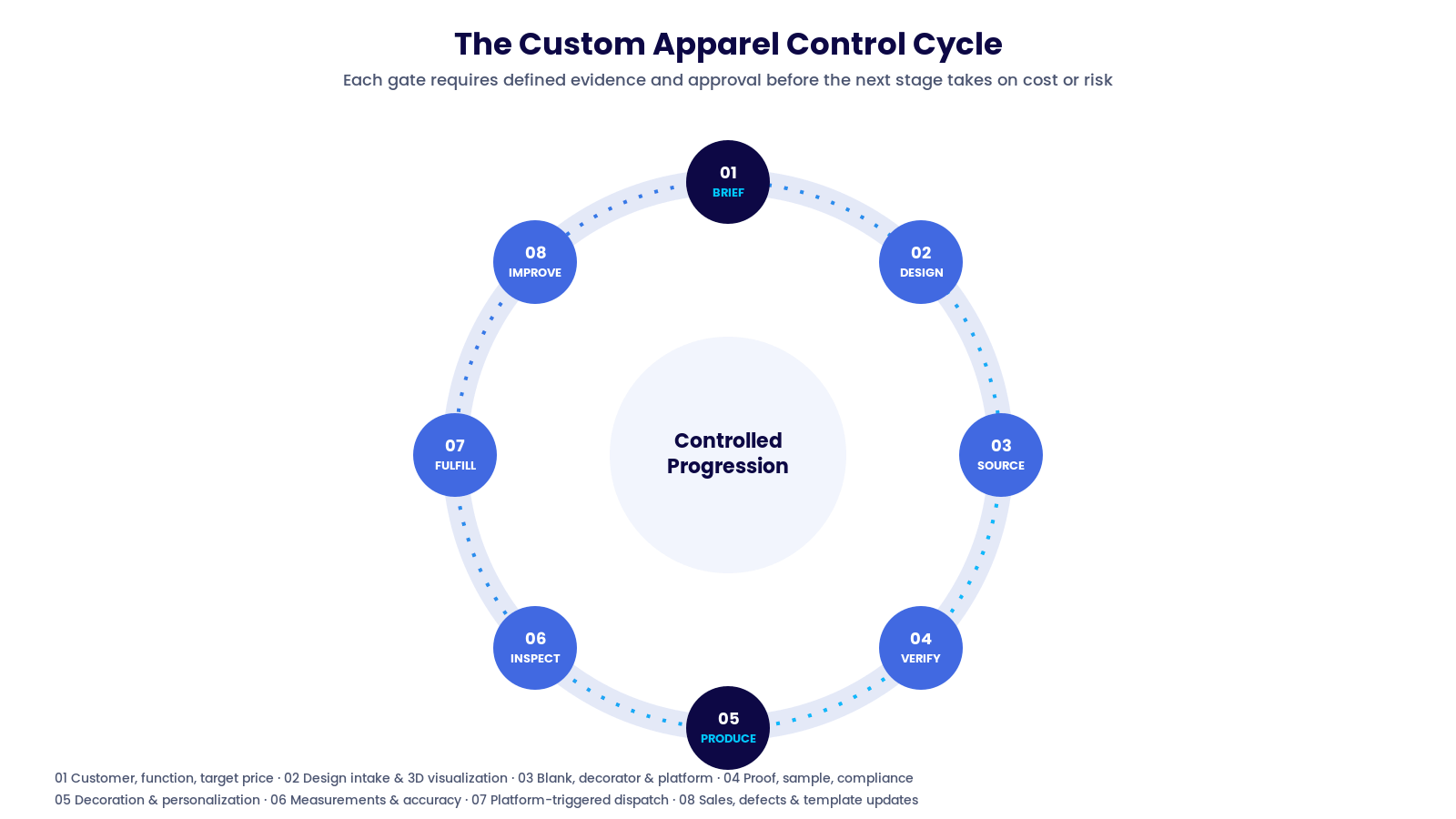
The custom apparel control cycle: every order — from a single custom piece to a 500-unit team kit — moves through the same eight gates.
The rest of this guide walks through each stage.
Everything starts with a production-ready brief — not a mood board. A usable brief specifies the product, target price, decoration method, personalization fields, fit, construction level, and launch timing clearly enough that a supplier or platform can quote and configure against it without guessing.
From there, the question everyone asks is how to find a clothing manufacturer or decoration partner worth committing to. The best partners aren't necessarily the largest, closest, or cheapest — they're the ones whose proven capability, order economics, and quality system actually match your product and decoration method. Build a longlist from credible sources, then compare using the same evidence and questions for every candidate:
| Check | What to ask for | Why it matters |
|---|---|---|
| Capability | Comparable production examples in your decoration method | Portfolio photos aren't proof — ask for physical samples |
| Capacity | Realistic lead time at your order volume | A supplier's best case timeline is rarely their normal one |
| Quality system | Their inspection process and defect records | Tells you whether problems get caught before they reach you |
| Communication | Response time and clarity during the sales process | Predicts what post-sale support will actually look like |
Sourcing is a two-track qualification process: blank-garment capability and decoration capability — verified independently, not assumed from a single vendor relationship.
Once you've shortlisted, verify before you commit — certifications, references, and a trial order, in that order.
This is the stage that separates custom apparel manufacturing from plain garment manufacturing, and it's the one most "how clothing is made" guides skip entirely.
A modern customization process runs in five parts:
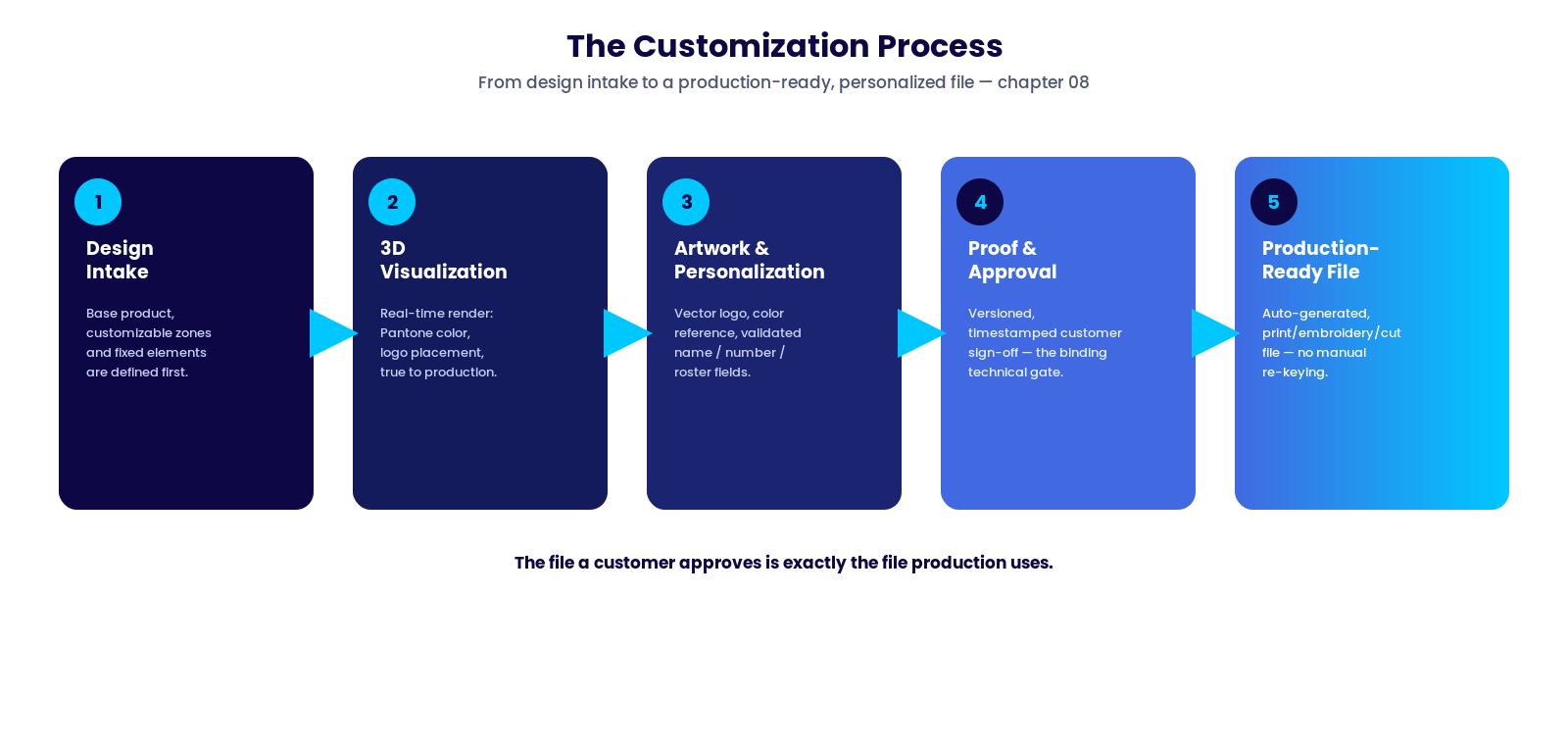
From design intake to a production-ready file — the stage that separates custom apparel manufacturing from generic garment manufacturing.
The apparel tech pack sits at the center of this stage. It's the single document that carries construction specs, decoration placement, color codes (Pantone reference included), and personalization rules — the same document your BOM, your decorator, and your quality checks all reference back to. Get this stage wrong and every downstream step inherits the error.
Every apparel business runs on some kind of software stack, whether that's a purpose-built platform, a set of disconnected point tools, or a spreadsheet and an email thread. The stack you choose is now as consequential to production quality as the decorator you choose.
A modern apparel customization software stack typically covers five functional layers:
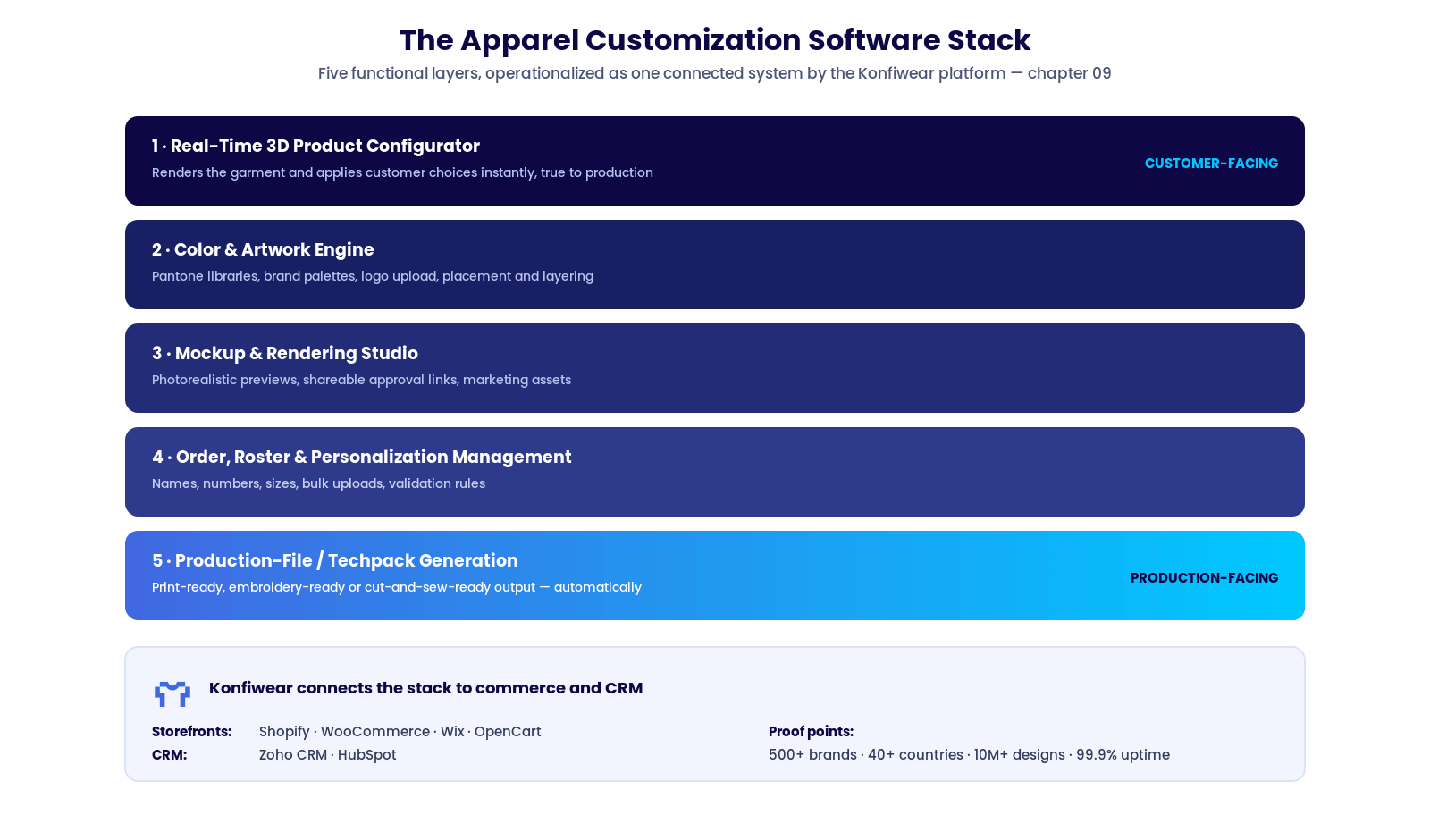
Five functional layers, operationalized as one connected system rather than five disconnected tools.
This isn't only a cost decision — it's a speed and control decision. Building a custom 3D configurator, color engine, and tech-pack generator in-house demands ongoing engineering investment most apparel businesses don't carry as a core competency. A purpose-built platform converts that investment into a subscription and lets your team focus on catalog, decoration quality, and customer relationships instead.
Konfiwear is one purpose-built option in this category — an apparel customization platform used by 500+ brands in 40+ countries, running on 99.9% uptime, with plans starting from €90/month and a 14-day free trial on the Pro tier.
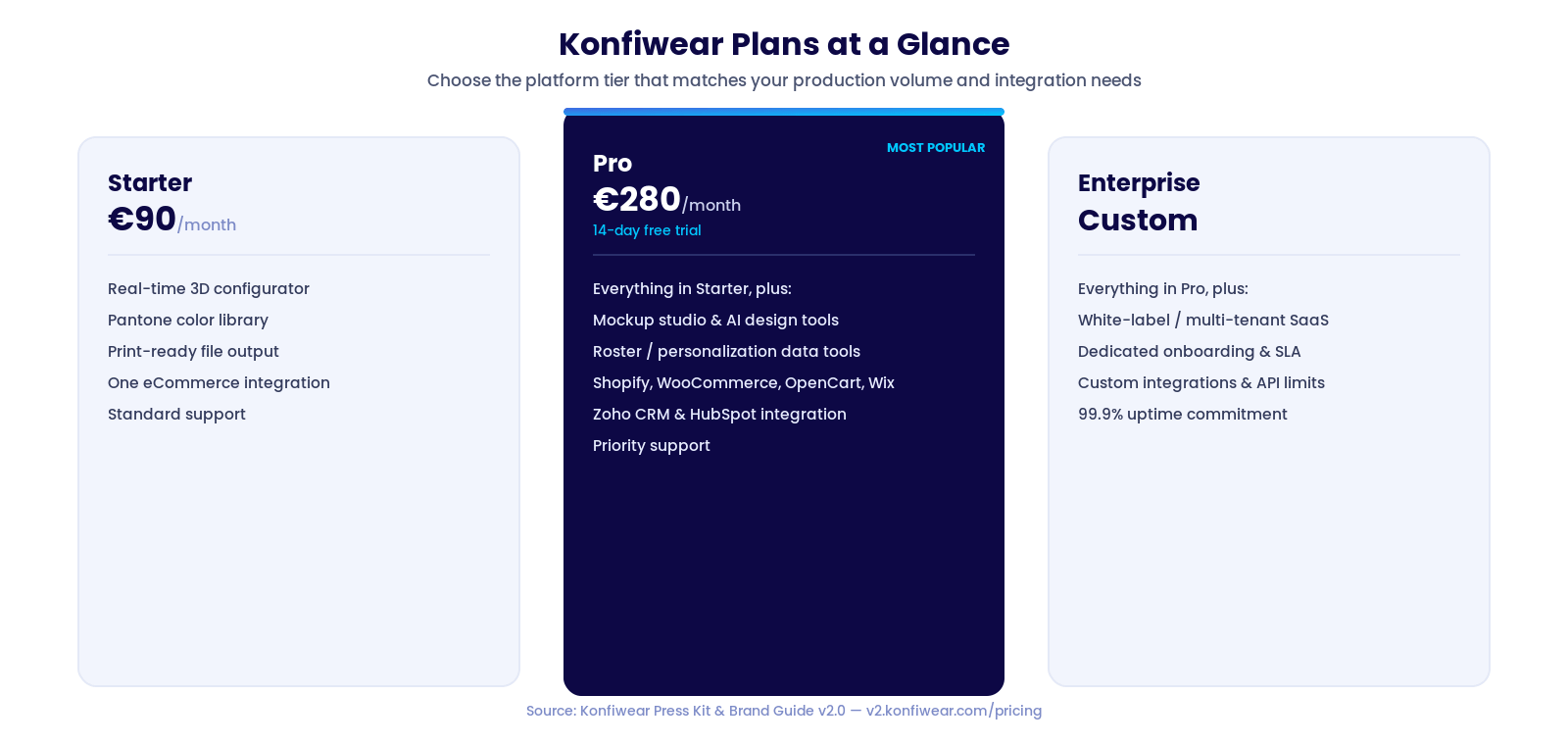
Whatever platform you evaluate, weigh it against real criteria: rendering accuracy, Pantone/color depth, personalization and roster handling, production-file automation, integration coverage, white-label capability, and total cost of ownership — not sticker price alone.
Whether you build, buy, or stay on point tools, audit your current stack against those five layers before your next catalog expansion — gaps show up as manual hand-offs, and manual hand-offs are where decoration and personalization errors get introduced.
The bill of materials, or BOM, is the component-level control sheet for a custom product — and for decorated apparel it has to cover physical and digital components with the same discipline. That means the approved artwork file, the Pantone reference, the digitizing file (for embroidery), and the personalization-data schema all need their own line, description, and approval status, exactly like a blank, trim, or thread color would.
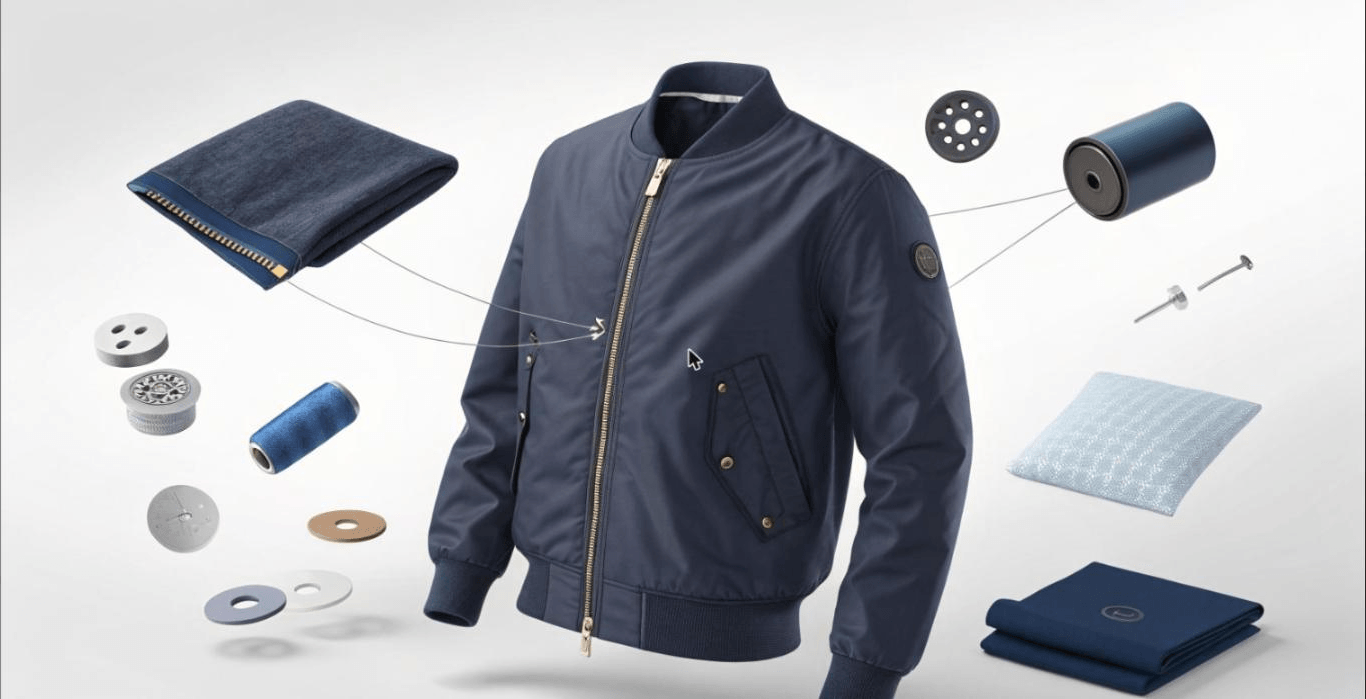
A strong BOM prevents substitutions, exposes long-lead components early, and connects material and design approvals to costing and production.
Costing follows the same principle: build your per-unit customization cost — decoration method, personalization complexity, and MOQ all move the number — before you quote, not after.
Once a design is approved and costed, production control takes over. This stage runs on two timing models at once: single-unit, order-triggered production (print-on-demand) and larger, roster-driven batch runs (team orders, seasonal drops). Both need the same underlying discipline — digital proofing before physical sampling, a locked roster before cutting or decoration begins, and a production calendar that exposes dependencies instead of hiding them until a deadline is missed.
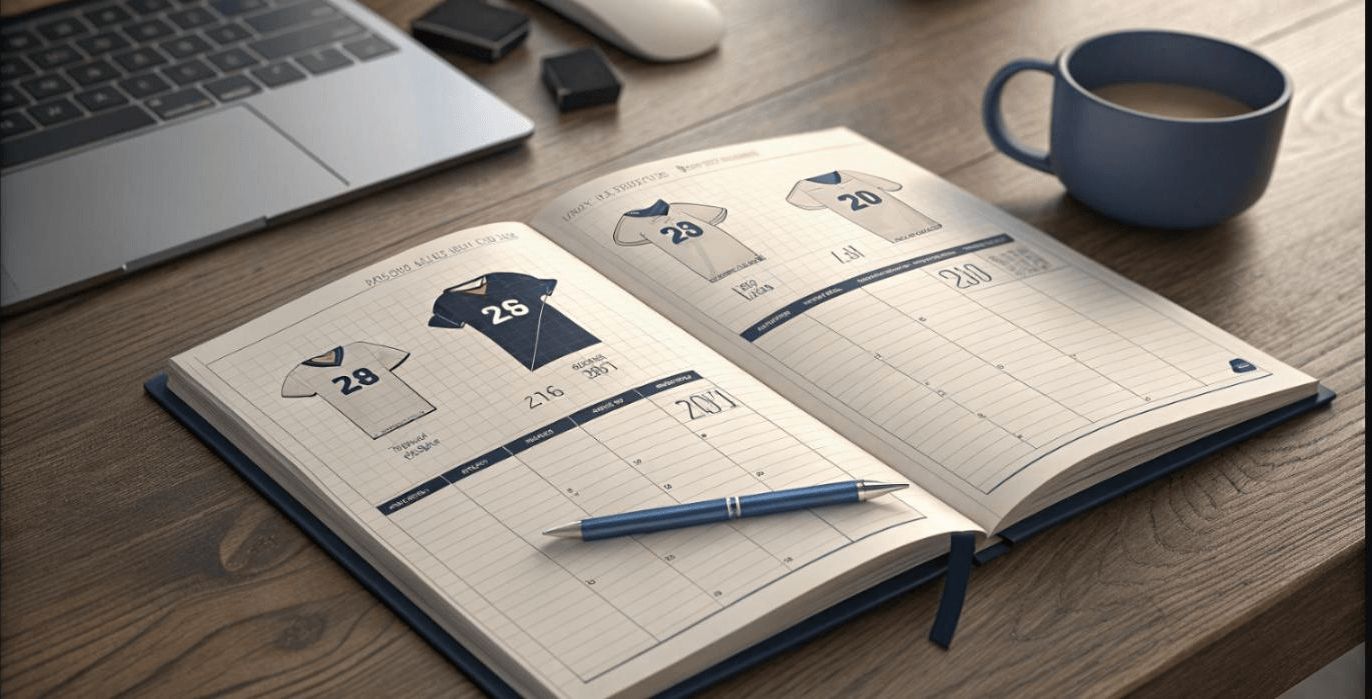
Plan backward from delivery for the correct order type, and treat every roster edit after cutoff as a formal change request — not a quick favor.
Labels, packaging, and compliance requirements get built into this stage too, not bolted on afterward — especially where per-order personalization (a name, a number, a size) has to reliably connect to the correct individual garment inside a batch of otherwise identical products.
Quality control for custom apparel compares the finished product against an agreed standard that includes decoration and personalization accuracy — not just construction quality. That distinction matters because statistical sampling, the standard AQL approach used across the wider garment industry, works differently once personalization enters the picture: sampling can tell you a batch's construction quality within a known confidence level, but it cannot tell you that unit #37's name is spelled correctly. That requires a full, non-sampled verification pass against the locked roster before packing.
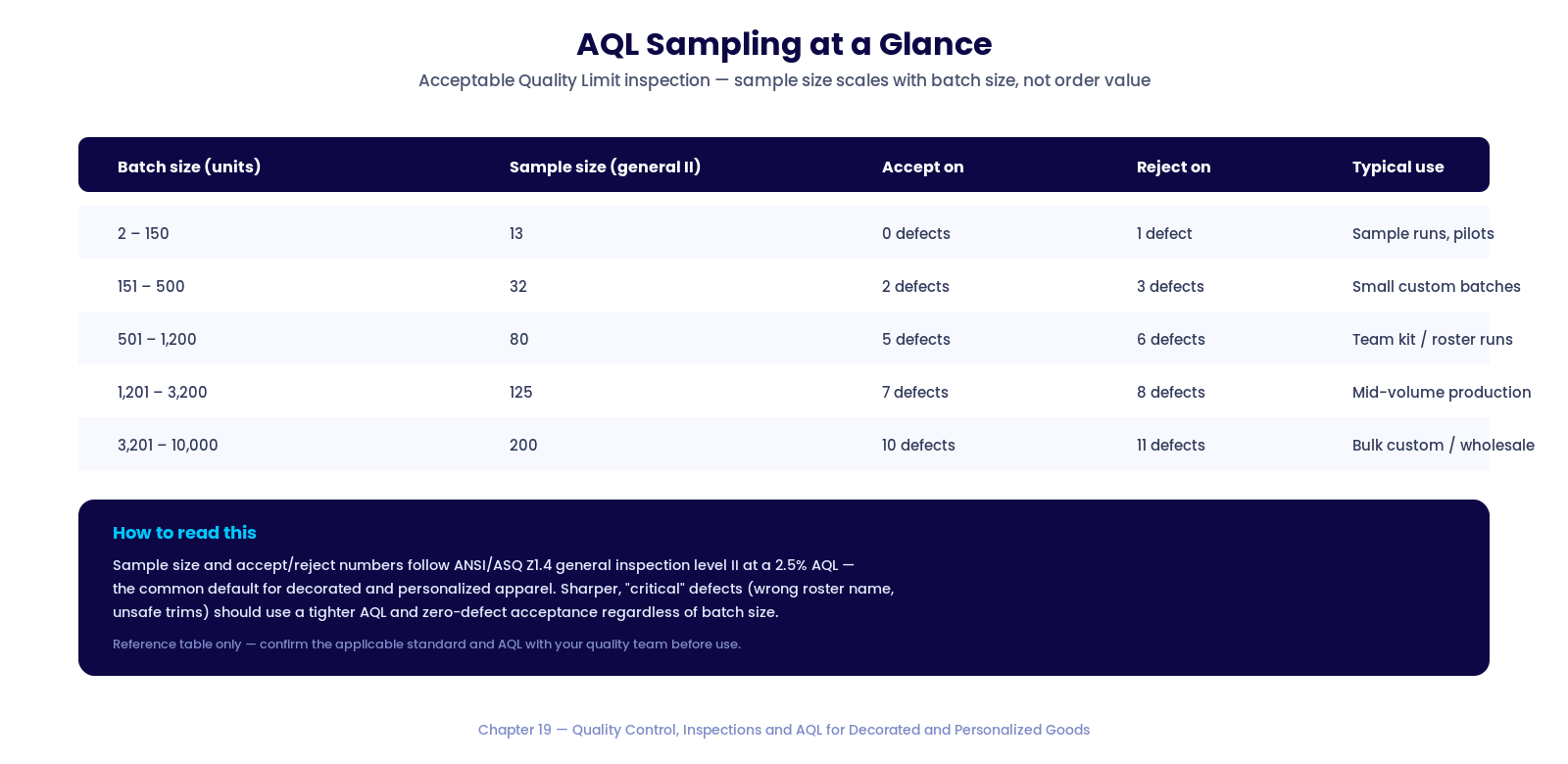
Sample size and accept/reject numbers follow general inspection level II at a 2.5% AQL — the common default for decorated and personalized apparel. Confirm the applicable standard with your quality team before use.
The practical rule: use AQL sampling for construction defects, and use 100% verification for anything tied to an individual name, number, or recipient.
This is the section most "how clothing is made" guides never touch, and it's the one that matters most if decoration is your actual business. Five methods dominate custom and team apparel, and each has a different profile for setup complexity, color range, durability, and ideal order volume.
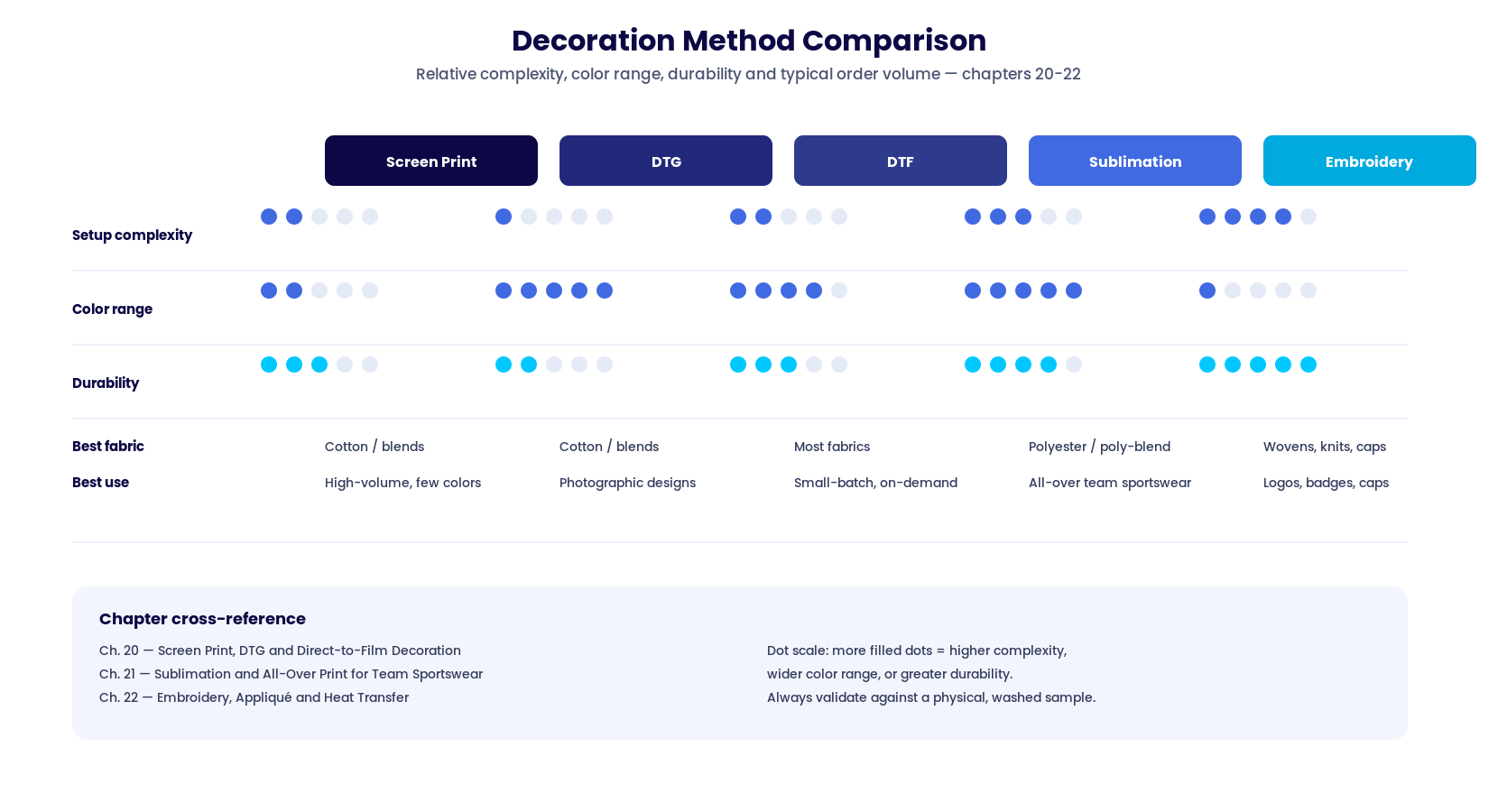
Dot scale: more filled dots = higher complexity, wider color range, or greater durability. Always validate against a physical, washed sample before committing to a method at volume.
A fast way to read the table: screen printing wins on high-volume, few-color orders; DTG wins on photographic designs in small runs; DTF wins on small-batch, on-demand work across almost any fabric; sublimation wins for all-over team sportswear on polyester; and embroidery wins on logos, badges, and caps where durability matters more than color range.
Team kits, club uniforms, and event-based apparel combine every risk in this guide at once: multiple decoration methods, a locked roster of individual names, numbers, and sizes, sponsor or league placement rules, and a fixed delivery date that cannot move. Success here depends on treating the roster as the primary production document and building the schedule around it — not treating personalization as an afterthought bolted onto a standard bulk order.
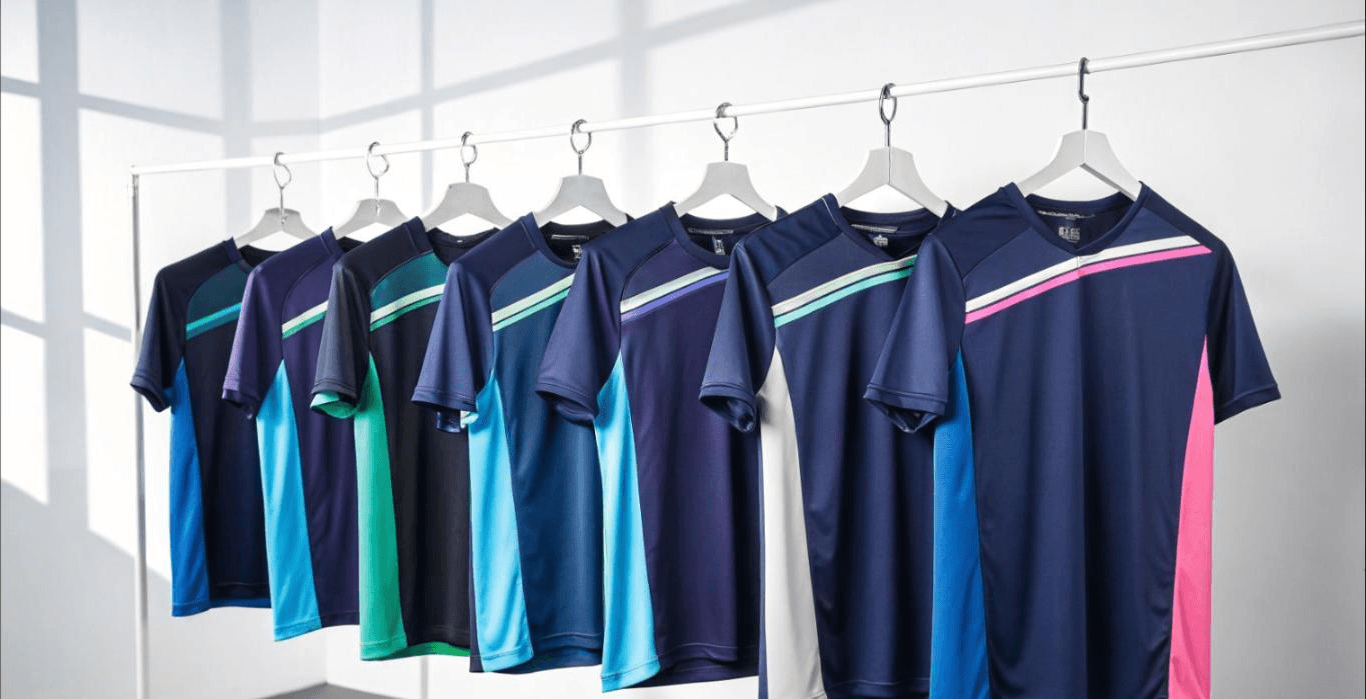
A single kit may combine sublimated base fabric, an embroidered club crest, and heat-transfer sponsor logos — sequence and coordinate deliberately, don't assume one decorator handles all three equally well.
For a custom uniform manufacturer or team-kit supplier specifically, the roster-first approach isn't optional — it's the difference between a clean bulk order and a reconciliation nightmare on delivery day.
On-demand apparel manufacturing follows the same logic at the other end of the volume spectrum: narrow your color and product choices deliberately, validate personalization data before it reaches production, and reserve cash flow for correction rather than betting everything on a single batch being perfect.

The system only works if problems feed forward. Every mistake below is cheaper to catch as a process fix than as a returned order.
What is the apparel manufacturing process? It's the full sequence from brief to delivery: sourcing and supplier verification, design and customization, cutting and decoration, sewing and assembly, quality control, and shipping. For custom and decorated apparel, it also includes digital design approval, production-file generation, and personalization-data management.
What software do apparel manufacturers use? Most modern operations run some combination of a 3D product configurator, a color/artwork engine, a mockup and rendering studio, order/roster management, and production-file generation — either as separate point tools or as one connected platform. Which approach fits depends on catalog size, order volume, and whether personalization or team-kit orders are part of the business.
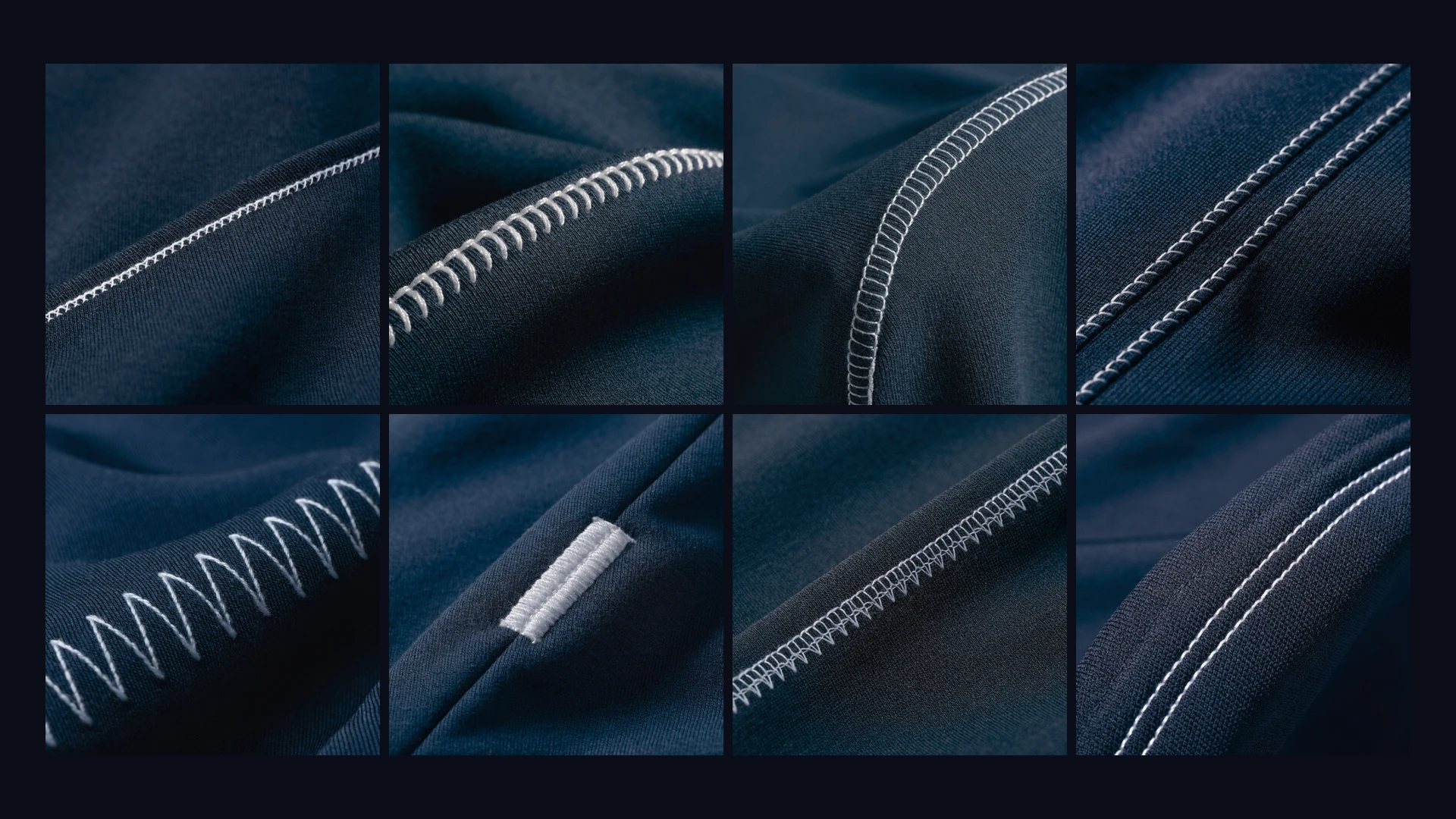
How do you quality-check personalized or decorated apparel? Use standard AQL statistical sampling for construction defects (stitching, fabric, fit), but use full, non-sampled verification for anything tied to an individual name, number, or recipient — sampling cannot catch a single wrong name in a roster of fifty. For stitch-type selection and common seam failures on teamwear, see the custom sportswear stitch guide.
What's the difference between on-demand and batch apparel production? On-demand, or print-on-demand, production is single-unit and order-triggered — you produce after the order is placed. Batch production is roster- or forecast-driven and larger in volume, typical of team orders and seasonal drops. Most custom apparel businesses run both models at once and need a production calendar that accounts for both.
How do I find the right apparel manufacturer for my brand? Build a longlist from trade directories, industry referrals, and decoration-specific networks, then qualify on capability (request comparable production examples), capacity (get a realistic lead time, not a best case), and quality system (ask about their inspection process) — not on price or proximity alone.
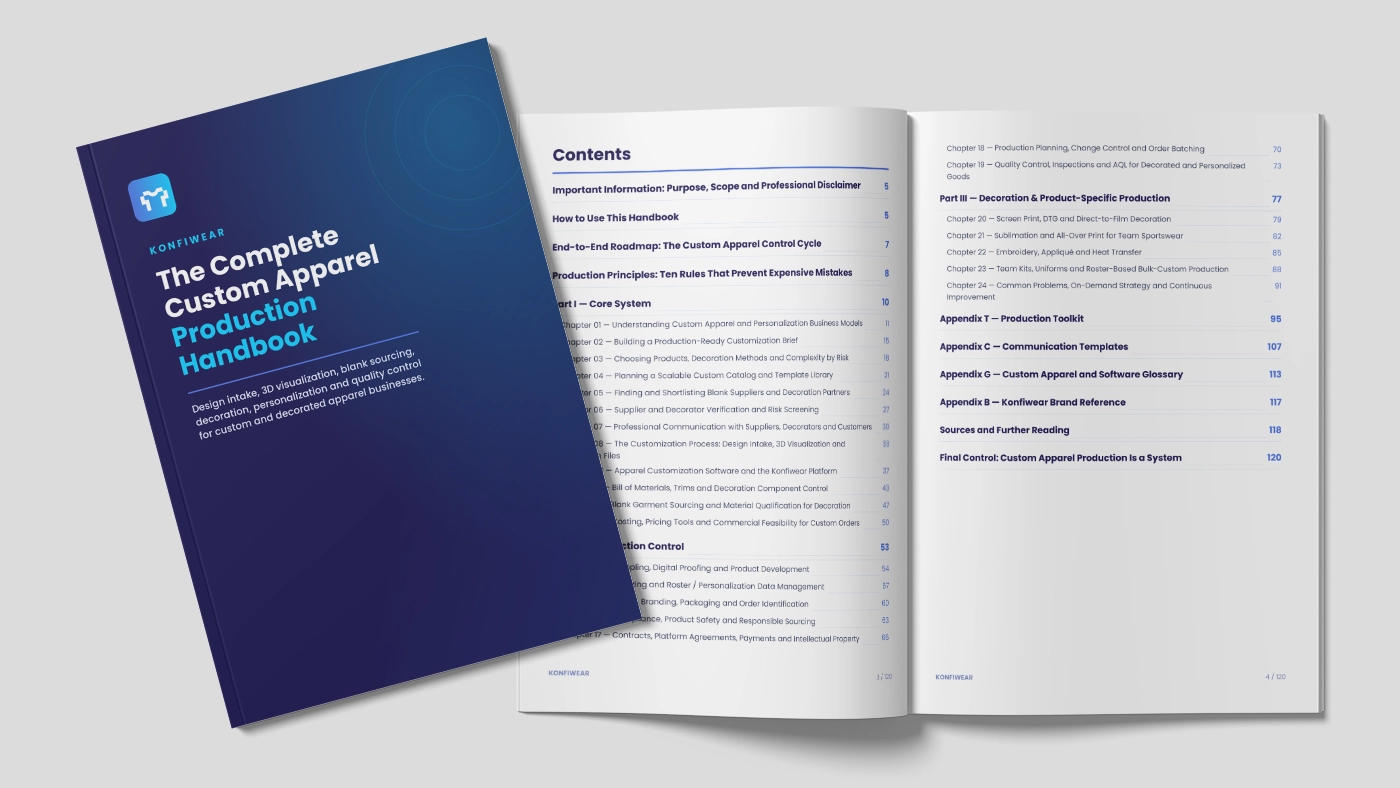
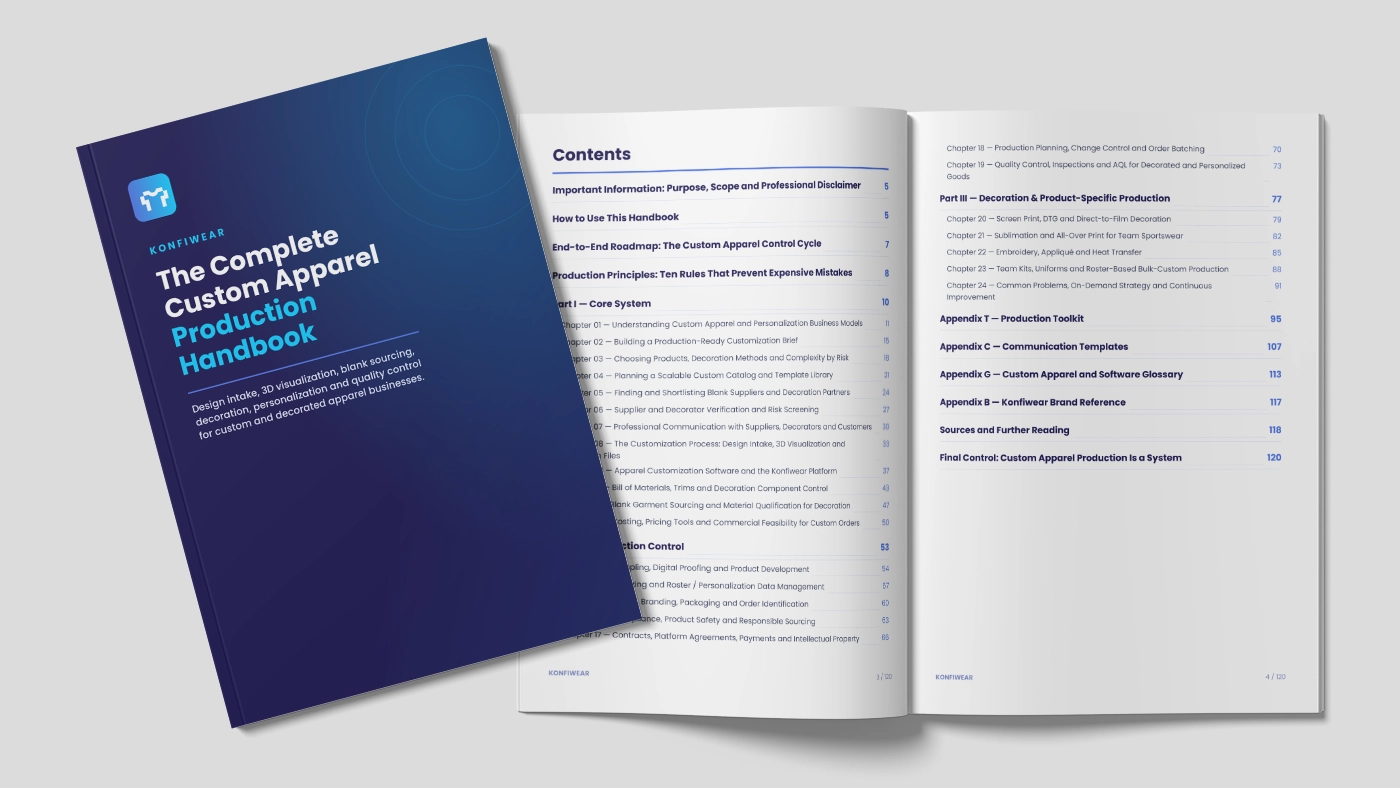
The businesses that scale in custom apparel treat every stage in this guide as a repeatable system — not a set of one-off decisions made fresh for every order. That system is exactly what this guide is adapted from: The Complete Custom Apparel Production Handbook, a 120-page reference covering all 24 chapters behind these eight stages, with worksheets, communication templates, and a full decoration-method and software-evaluation toolkit.
If the software layer in Stage 4 is the gap in your current process, Konfiwear is built to close it — a 3D configurator, color engine, mockup studio, and production-file generation in one connected platform, integrated with Shopify, WooCommerce, Wix, OpenCart, Zoho CRM, and HubSpot.