Custom Apparel Process: With vs Without a 3D Configurator
See every step of the custom apparel process — design, quoting, production, delivery — and how a 3D product configurator fixes the slow parts.
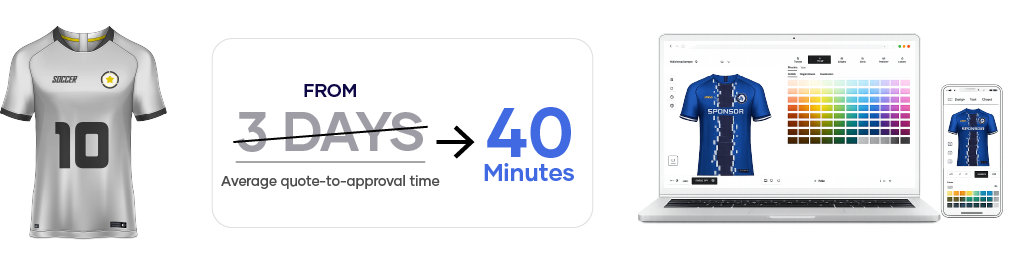
The average custom sportswear quote takes three days. Konfiwear customers average four hours. That gap doesn't come from one clever feature — it comes from removing the friction at every single step between "I want custom jerseys" and "the box arrived."
Most teams, schools, and brands still run that journey the traditional way: email threads, flat 2D mockups, spreadsheets for sizing, and a production team translating someone else's file by hand. It works, eventually. It also loses orders, burns days on revisions, and turns small mistakes into expensive reprints.
A club treasurer approves a jersey design that looks right in an inbox preview. Three weeks later, forty jerseys arrive in a blue that doesn't match the club crest, and half the roster's sizes are wrong because they were collected over text. Nobody made an obvious mistake — the process just wasn't built to catch it. That's the gap this post is about.
This post walks through the standard custom apparel process step by step, the pain points built into each stage, and exactly what changes when a real-time 3D product configurator sits in the middle of the workflow instead of a stack of email attachments.
The Standard Custom Apparel Journey, Step by Step
Whether it's a youth soccer club ordering forty jerseys or a print shop fulfilling a 500-unit corporate order, the process follows the same five stages:
- Design & briefing — colors, logos, names, numbers, sizing
- Quoting, mockups & approval — pricing, proofs, sign-off
- Sampling & file prep — lab dips, prepress, techpacks
- Production — cutting, printing or sublimation, sewing
- Quality control & delivery — inspection, packing, shipping
Industry guidance typically recommends starting six to eight weeks before a season opener or launch date, to leave room for design, proof review, revisions, production, and shipping with a buffer for the unexpected. That buffer exists almost entirely because stages 1–3 are unpredictable in a manual workflow — nobody pads a timeline for cutting and sewing, which run on a known schedule. They pad it for revision cycles that can run three, four, or five rounds before a design gets approved.
Each stage has a well-documented failure point. Here's where they show up — and how an apparel customization platform closes the gap.
Step 1: Design & Briefing
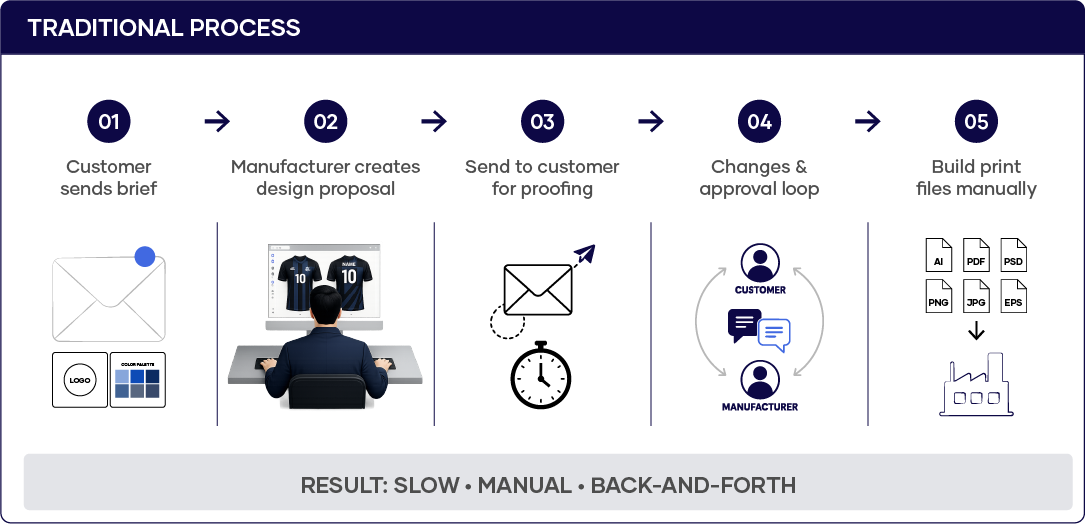
Without a configurator: This is where most orders go wrong before production ever starts. Teams submit a low-resolution logo screenshot from a phone, colors get described in words instead of Pantone values, and sizing gets collected in a group chat where half the players guess. Rushing into a request without a clear, structured brief is the single most common mistake kit managers make — it leads to vague pricing and several rounds of back-and-forth before anything is actually built.
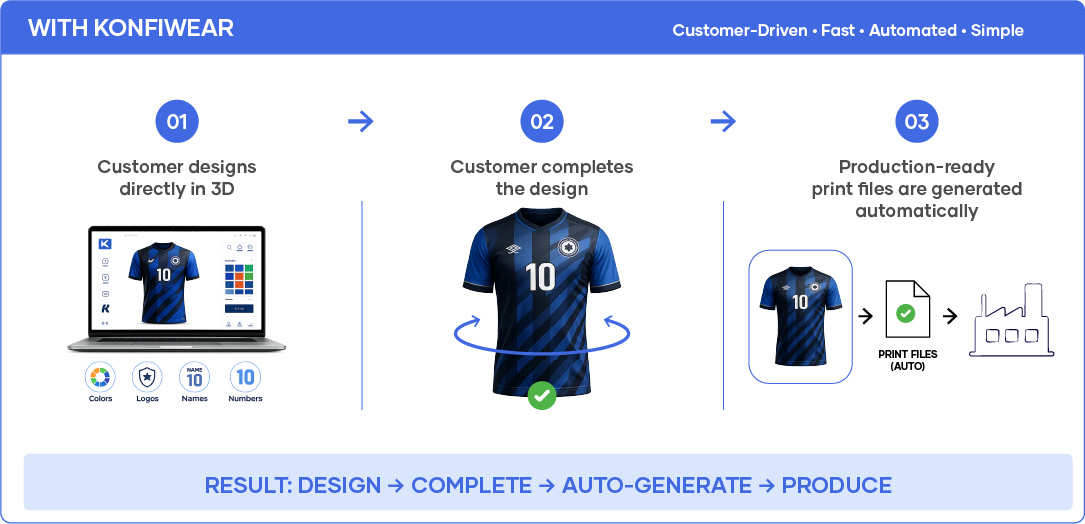
With Konfiwear: The customer designs directly inside a real-time 3D product configurator — rotating, zooming, and placing logos, names, and numbers on a true garment model instead of describing them in an email. Roster management is built into the same flow, so player sizes are captured against the actual design, not a separate spreadsheet that never gets updated. AI-powered tools handle logo background removal and layout suggestions automatically, cutting out the back-and-forth of "can you send that without the white box around it."
The practical effect: the brief and the design become the same artifact. There's nothing to misinterpret because there's nothing left to describe in words.
Step 2: Quoting, Mockups & Approval
Without a configurator: Flat 2D mockups are static image overlays — no interaction, no accurate drape, and colors that look different on screen than they do off the press. Every requested change means a new file, a new email, and a new wait. This is the stage where the three-day industry-average quote turnaround actually happens, and where a rush surcharge can add 20% to the cost of a standard order. It's also where deals quietly die: buyers rarely abandon a custom order over price — they abandon it over uncertainty about what they're actually going to receive.
With Konfiwear: Pantone-accurate color customization means the color a customer selects on screen is the exact color that ships to production — no drift, no reinterpretation by a second person. The built-in mockup studio generates photorealistic 3D renders and shareable approval links instantly, so sign-off happens in one sitting instead of one week. Removing that uncertainty is a large part of why quote-to-approval time drops from an industry average of three days to roughly four hours for Konfiwear customers.
Step 3: Sampling & File Prep
Without a configurator: First-time orders typically need three to five days just for lab dips and prepress — before a single unit is cut. Files pass from designer to production team by hand, and that hand-off is where design-to-production translation errors creep in: wrong bleed, wrong color profile, a techpack that doesn't match the approved mockup. A techpack is the technical spec sheet a factory works from — measurements, placement, materials — and when it's built manually from a flat mockup, small gaps between what was approved and what was specified are easy to miss until the sample comes back wrong.
With Konfiwear: When a design is finalized, production-ready files generate automatically — correct DPI, correct color profile, zone-separated artwork, no manual prep. There's no translation step between "approved" and "producible," which is also where most reprints originate in a manual workflow. The techpack is generated from the same design the customer signed off on, not redrawn from a screenshot of it.
Step 4: Production
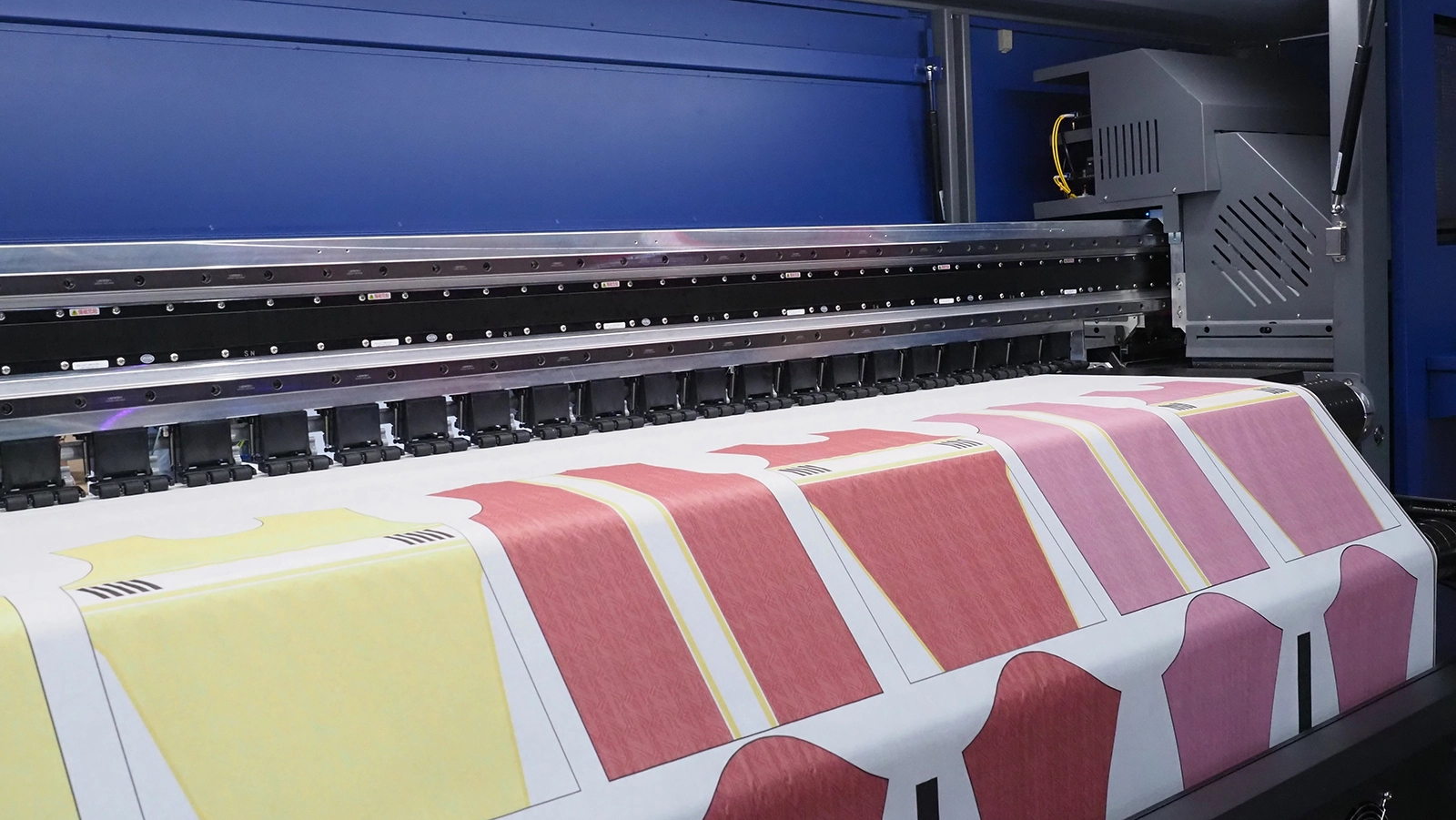
Without a configurator: Physical production has real constraints a software platform can't remove — setup time on a sewing line can run four to six hours per style, and decoration methods like screen printing carry minimum order quantities of 50 units or more because each color needs its own hand-prepared screen, while sublimation runs typically need panels to rest 12–24 hours after printing before cutting. What can be removed is the error rate: a mistranslated file caught at the cutting table costs far more than one caught on screen, because it means re-cutting fabric, rebooking a production slot, and pushing the whole order past its deadline.
With Konfiwear: Because the file that reaches the production floor is the same file the customer approved, production teams spend their setup time producing instead of correcting. Konfiwear doesn't replace your factory relationships or your decoration method — whether that's sublimation, DTG, or embroidery — it removes the errors that turn a normal production run into a reprint.
Step 5: Quality Control, Sizing & Delivery
Without a configurator: Sizing is where most orders quietly fall apart. A coach collects shirt sizes over text, guesses fill in the gaps, and the finished box fits nobody consistently — leading to last-minute scrambles, partial reorders, and a team that's frustrated before the first game. Every reorder to fix a sizing mistake also resets the clock: another production slot, another shipment, another wait.
With Konfiwear: Sizing is captured per player at the design stage and tied directly to the approved artwork, so what ships matches what was actually ordered — not what was guessed at three weeks earlier. Fewer sizing mismatches means fewer reorders, and fewer reorders means the delivery date that was promised at the start actually holds.
The Full Comparison: With vs Without Konfiwear
| Stage | Without a 3D configurator | With Konfiwear |
|---|---|---|
| Design & briefing | Low-res logos, verbal color descriptions, sizing via group chat | Real-time 3D design, Pantone-accurate colors, built-in roster management |
| Quoting & approval | ~3-day average turnaround, flat 2D mockups, endless revision emails | ~4-hour average turnaround, photorealistic 3D mockups, instant approval links |
| Sampling & file prep | 3–5 days prepress, manual techpacks, hand-off translation errors | Automatic production-ready output the moment a design is approved |
| Production | Real factory setup time and decoration MOQs still apply | Same production reality — but far fewer reprints from file errors |
| QC, sizing & delivery | Guessed sizes, mismatched shipments, reorders | Sizing tied to the approved design, matched to what was actually built |

Customer Empowered

Instant Results

No Back-and-forth

Fewer Errors

Faster Production
Common Questions About Optimizing the Apparel Process
Does a 3D configurator replace my production team or factory? No. Konfiwear generates the design, the approval, and the production-ready file — it doesn't cut, print, or sew. It plugs into the production relationships and decoration methods you already use, and hands your team a file with no guesswork left in it.
What if I already have a manual quoting process that works? The comparison isn't "broken vs. working" — it's "slow vs. fast." A manual process that produces the right jersey eventually still costs three days of quote turnaround and several rounds of revisions that a real-time 3D configurator removes.
Does this fit into an existing online store? Konfiwear integrates natively with Shopify, WooCommerce, OpenCart, and Wix, so the configurator sits inside the store your customers already use rather than sending them to a separate design tool.
What Actually Changes When You Optimize the Journey
None of this changes the physics of cutting, sewing, or heat-pressing fabric — that part of custom apparel is still a real, physical production process. What changes is everything upstream of it: how fast a design gets approved, how accurately a file reaches the production floor, and how many of those units come back wrong. Konfiwear is trusted by 200+ apparel brands in 20+ countries to run exactly that part of the journey, with 10M+ designs created and 99.9% platform uptime behind it.
If your team is still running this process through email threads and flat mockups, the fastest way to see the difference is to design something yourself.
Start your 14-day free trial — no credit card required →
Plans start from €90/month. See how it connects to your store on Shopify or check pricing for the plan that fits your production volume.